Sunday, 20 October 2019
Western Grasswrens at Monkey Mia, WA
The enigmatic grasswrens are usually high up on any birders most wanted list when they visit Australia, but they are always difficult birds to connect with, mainly because they usually inhabit very remote and hard to get to places. You can't just fly to Sydney and see them during a walk around the botanic gardens!
Not surprising therefore that I was delighted to see several western grasswrens at Monkey Mia today. Also today lots of waders including Terek sandpiper, great knot, red-necked stint and red-capped plover, and terns were again well represented, with at least 40 Caspian as well as a few each of crested and lesser crested and fairy terns, the latter being a new tern for the holiday list.
Friday, 18 October 2019
A walk along the beach at Coral Bay, WA
The walk from Five Fingers Reef, through Coral Bay, to the headland north of Shark Lagoon is about 15km but well worth the effort, with turquoise seas and fine white sand beaches at the base of large sand dunes, the scenery is just stunning. Terns dominate here and during our stay I managed to see eight different species of tern of varying shapes and sizes as you can see from this photo!
Wednesday, 16 October 2019
A walk along the beach at night, Cape Range
Last night we had a walk on a remote beach at Cape Range in Western Australia, which is about 20km from Exmouth, the nearest town. It was a full moon and we came across a female green turtle egg laying on the beach. To give you an idea of the size of this magnificent animal, it's about 1.5m from nose to tail and weighs approximately 160kg (25 stone). The hole in the sand which it was digging is around 2m diameter. Yet another amazing experience on this holiday. We didn't stay with it too long not wanting to disturb it, and fortunately we had red light on our head torches which causes minimum disturbance to nocturnal animals. All of these photos were taken on my phone which is a Google Pixel 4a, on the night setting.
Tuesday, 15 October 2019
Budgies!
When I was a kid we had a pet budgie, shamefully held captive is a small cage. Today in my fourth visit to Australia I finally caught up with a wild budgerigar at Exmouth sewage works. Truth to tell I've been seeing flocks of up to 30 birds flying over for a day or two now, but they never seem to land until today, when I spotted this cracking female sitting on the perimeter fence.
However, just because we remember budgies with affection from our childhood doesn't mean that we should under estimate them or regard them as "plastic" or feral in anyway. I've heard budgerigars described as the hardiest of all Australian birds, they live in extreme environments in the baking heat of the arid heart of Australia and are nomadic, flocking together in huge numbers in their search for water and food. How awful to keep a bird with such a lifestyle in a tiny cage, yet pet shops still sell them and people still keep them.
Monday, 14 October 2019
Perentie Lizard and Long-nosed Dragon, Exmouth, WA
Perentie lizards are the largest and most impressive of all Australian lizards, often growing up to 2.5m long. This particular individual at Exmouth sewage works was probably about 1.5m, but still an impressive animal.
Little Curlew, Exmouth, WA
![]() |
| Photo: adult little curlew. |
In 1985 I was on a long weekend birding in Norfolk with my dad when a little whimbrel was found at Blakeney. It was the second for Britain or possibly the first if it was a returning bird, and I don't think that there have been any since. Now approaching 35 years since the last UK record, it's about as close as it gets to a blocker on my UK list following the fall of Hudsonian Godwit a year or two ago. I'm pretty sure at the time that it was considered an endangered species like so many of it's curlew / whimbrel cousins. These days the name has changed to little curlew and I don't think it is quite as endangered as we thought back then but still a very difficult bird to connect with anywhere.
I never thought that I would ever see another little whimbrel, yet on the same day that I encountered my first flock of budgies flying over Exmouth sewage works I also came across eight little curlews with banded lapwings on a nearby playing field.
Sunday, 13 October 2019
Around Exmouth
Exmouth is an amazing place, not a particularly beautiful town, but it really feels like you are in the outback or in a frontier town. Emus walking around the streets, warning signs about dingos and some familiar species not looking quite so familiar as I expected.
Take the bird above for example. It's a crested pigeon, quite common across all of Australia including in the major cities of the south and east.This however is of the western race whitlocki which seems to me to be much brighter than others I have seen.
Cape Range on the North West Cape
![]() |
| Photo: Euro. |
This is where the desert meets the sea, the vegetation on land is very scrubby, there are no trees, warnings of dingos, very little freshwater and daytime temperatures can easily reach 50'C in summer. Not that you would want to be here in summer because not only is it unbearably hot, it's also cyclone season.
Red Kangaroo
Red kangaroos are the largest living marsupial, with adult males often attaining a height of 1.4m and weighing up to 85kg. They are quite a common and widespread species but mainly across the interior and so are difficult to see if you just stick to the coastal cities and resorts. The only places where their range extends down to the coast are in the Nullarbor region and the north west coast between Exmouth and Broome. This animal, photographed on the golf course at Exmouth, was my first red kangaroo on my 4th visit to Australia.
Saturday, 12 October 2019
Where the desert meets the sea - a Western Australia road trip
It's a long drive north from Perth to Exmouth on the west coast of Australia, nearly 13 hours in fact, and once past Geraldton the landscape becomes relatively flat and the vegetation sparcer. This is where the desert of central Australia meets the sea. It's a place where you really don't want to break down and where you need to have a full tank of petrol and plenty of water. One of the commonest raptors seen is the wedge-tailed eagle whilst the rarest is the black-bellied buzzard. All kinds of odd flowers grow here and there are termite mounds for as far as the eye can see, but the avian highlight of the trip for me was four Australian bustards right at the side of the road. A wonderful experience!
Friday, 11 October 2019
Return to Herdsman
Hersman Lake, just north of Perth is a fabulous birding site and a must for any visitor to the city. Last year I went there right at the end of my holiday in the hope of adding freckled duck to my Australian list, and though I succeeded the views were not great. Since then I have seen Australia's rarest duck well on several occasions in the Melbourne area last November. Today I had time to kill while I waited for Josh to fly into Perth airport for our road trip up the west coast, and I couldn't think of a better place to visit than Herdsman. This time the freckled ducks showed much better and allowed me to get some half decent photos.
Thursday, 10 October 2019
Botanising in the Jarrah woodland of the Darling Range
...or perhaps the post header should be "enjoying the flowers of the Jarrah woodland", because there certainly wasn't much botanising going on. I can tentatively put some of these plants into families but I just don't know enough about them to identify them to species level. Does that really matter though, I'm content to say that the Jarrah woodlands are a very special place with a stunning array of flowers and I'm happy to leave it at that. This post contains a selection of some of my favourites.
White-breasted Robin, Wungong Gorge, WA
White-breasted robin is endemic to south west Australia and is one of the reasons I wanted a week south of Perth before meeting up with Josh and heading north.
Wednesday, 9 October 2019
Western Grey Kangaroo
The only kangaroo in south west Australia is the western grey. I came across an approachable mob today, including this adorable female with a joey in her pouch.
Creery Wetlands, Mandurah, Western Australia
The fairy-wrens are beautiful family of birds, and here in south west Australia the common one so far has been the aptly named splendid fairy-wren.
Tuesday, 8 October 2019
Blue-billed Duck
Blue-billed duck is the Australian equivalent of the ruddy duck or white-headed duck, and despite seeing quite a few during my time in the country, this is the first time I've ever got anywhere near taking an ok photo of the species. This is a male, photographed at Dunsborough.
Blue Whale, Humpback Whale and Southern Right Whale, Dunsborough, Western Australia
| Photo: Blue Whale. |
Fortunately the animal did reappear and broke the surface several times giving us some great views, though not quite the vaudeville performance which is usually put on by humpbacks! Perhaps not quite up there with the Orca I saw off Caithness last year which were the highlight (so far) of my career as an amateur naturalist, but not far short and still a fantastic experience.
Busselton and Cape Leeuwin, Western Australia
What a stunner and what a great start to my latest trip to Aus! Banded Lapwing. It's taken a few visits for me to finally see one but it was worth the wait. Today I saw three on a grassy verge at the side if the road as I was leaving town to head for Cape Leeuwin. I pulled over, put the window down and watched as three birds fed in a flower filled grassy area. The bird in the photo walked towards me right up to the edge of the road and then actually walked across the tarmac and behind my car and onto the grass on the other side! Fortunately this was just a side road and traffic was very light and hopefully it wont do that in rush hour! Talking of flower filled meadows, there are lots of flowers at the moment so I'm putting together a rolling blog post of those I see and will post it here soon 😀.
Tuesday, 11 June 2019
Parrots, Lorikeets, Corellas, Rosellas and Cockatoos
![]() |
| Photo: Rainbow lorikeets. |
Sunday, 17 March 2019
Honeyeaters and bottlebrushes
![]() |
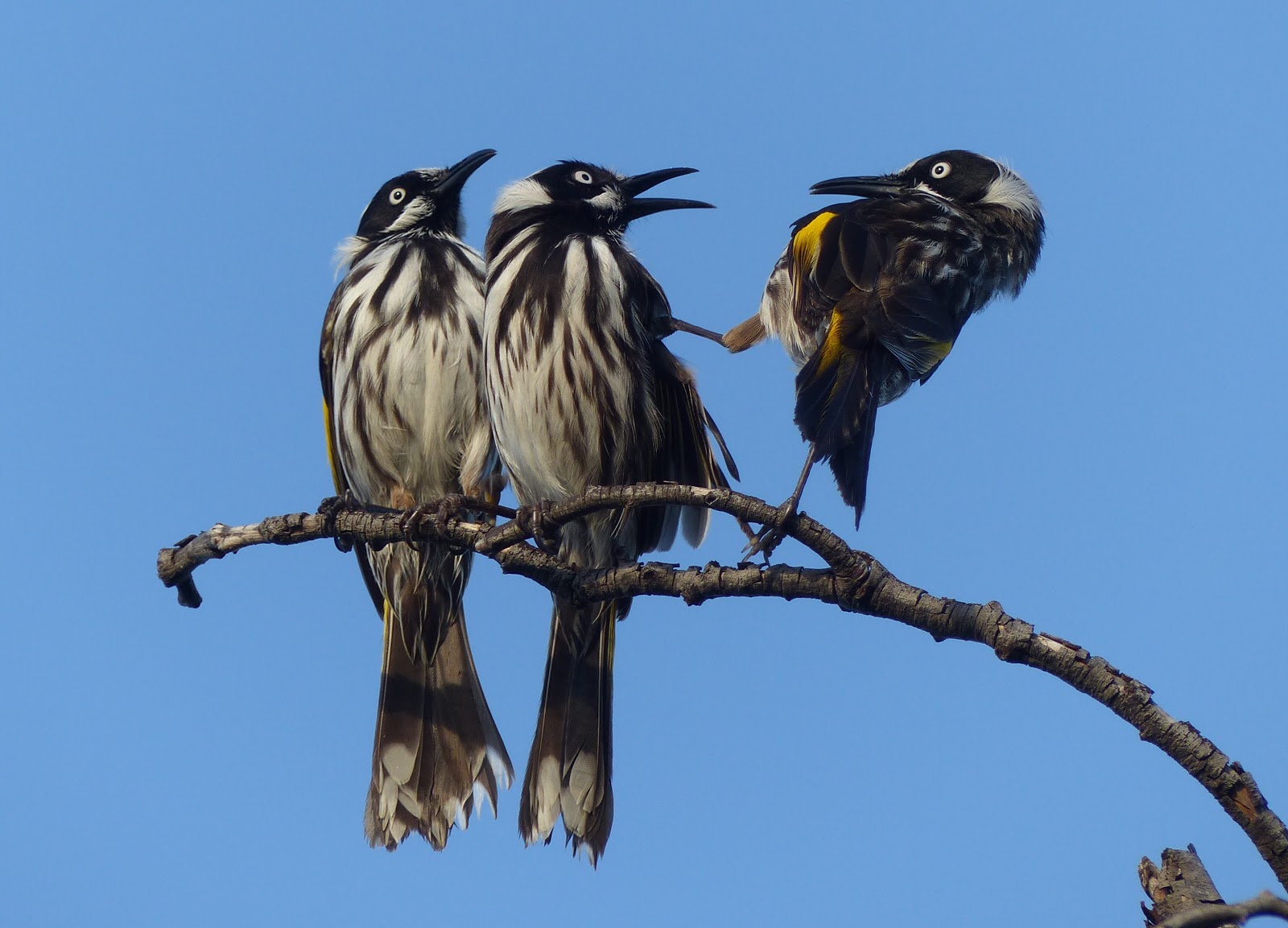
| Photo: New Holland Honeyeater. |
Subscribe to:
Posts (Atom)
-
Photo: New Holland Honeyeater. There are 76 species of honeyeater in Australia forming the largest family of Australian passerines. They...
-
Photo: Snowy albatross. "Wanderer at 6 o'clock!", the cry went up and sent shivers down my spine. This was the moment I ha...
-
Photo: Rainbow lorikeets. Parrots, lorikeets, corellas, rosellas and cockatoos include some of the most showy, noisy and colourful of al...