 |
| Photo: Mueller Lake with Mount Cook shrouded in cloud behind. |
Friday, 24 January 2020
On the Stairway to Heaven and the journey to Lake Pukaki


Thursday, 23 January 2020
Te Waewae Bay
 |
| Photo: Video grab of part of a flock of around 10,000 sooty shearwaters. |
Te Waewae Bay is on the south coast of New Zealand opposite Stewart Island and beyond that Antarctica. It can be a stormy place and there are even Tsunami warning signs on the beaches. However the day we chose to go was calm and sunny. Out at sea there were thousands of sooty shearwaters going past harassed by the occasional Arctic skua. Amazing to think that the skuas may be Scottish bred and even a few of the shearwaters may be regular visitors to the UK! Also today, at least three Hector's dolphins, one of the rarest and smallest dolphins in the world.
Wednesday, 22 January 2020
Milford Sound

Milford Sound was every bit as good as they told us it would be. Eighth wonder of the world according to some and I'm not going to disagree. Not much to report other than amazing scenery and superb weather. Two kea flew over the ferry terminal and a couple of great white egrets chased each other around.
Monday, 20 January 2020
Above the treeline

Grand though some of the famous New Zealand walking trails are, unless you are a serious hiker getting past the treeline seems to present a real problem. For example a couple of days ago Elaine did a 15 mile return hike on the Routburn track from Glenorchy and still failed to clear the trees. Similarly though I haven't done it yet, I have been told that it's also a 7.5 mile hike to clear the trees from the other end of the Routeburn at the Divide. That's 7.5 miles there, 7.5 miles back. Now, impressive though these forests are, dominated by wonderful bryophytes and ferns, and alive with birds, I really did want to try to get above the trees and see some of the alpine flora of New Zealand.
Today we found a route up to The Remarkables Ski area which allowed us to drive up to 1550m with not a tree in sight. From there we then hiked up to Lake Alta at about 1800m, before climbing even further to over 2000m. At this height we were very much in amongst scree and boulders and the there were plenty of alpine flowers about, though I didn't see a single bird.
Saturday, 18 January 2020
Riffleman and Yellowheads
 |
| Photo: Riffleman. |
Thursday, 16 January 2020
The Westland Glaciers
 |
| Photo: Fox Glacier. |
Wednesday, 15 January 2020
Experiencing Kiwi

Well nobody said that seeing kiwi would be easy but I didn't expect it to be quite so strange. Last time I was in New Zealand in 2018 I managed to see little spotted kiwi, this time I connected with great spotted kiwi and Rowi (also known as Okarito brown kiwi), but that only tells half the story!
Kiwi are nocturnal so that presents it's own set of problems, but they also live in woodland and all species are pretty rare. We were staying in Franz Josef Glacier, only about 15 miles from Okarito so I booked myself onto a tour run by Okratiro Kiwi Tours because this seemed the only realistic way of seeing a Rowi, the rarest of all the kiwi.
Tuesday, 14 January 2020
Kea at Arthur's Pass

Arthur's Pass is the gateway to the west coast of New Zealand when travelling from Christchurch and it is renowned for its friendly kea. These are large birds which are also known as mountain parotts and at Arthur's Pass they have become relatively tame and will even 'steal' items from unsuspecting tourists.
We saw about 4 birds in the village, and then two more at the Otira viaduct lookout. The latter were incredibly tame and one even came and pecked at my camera lens as I tried to take its photo.
Weka
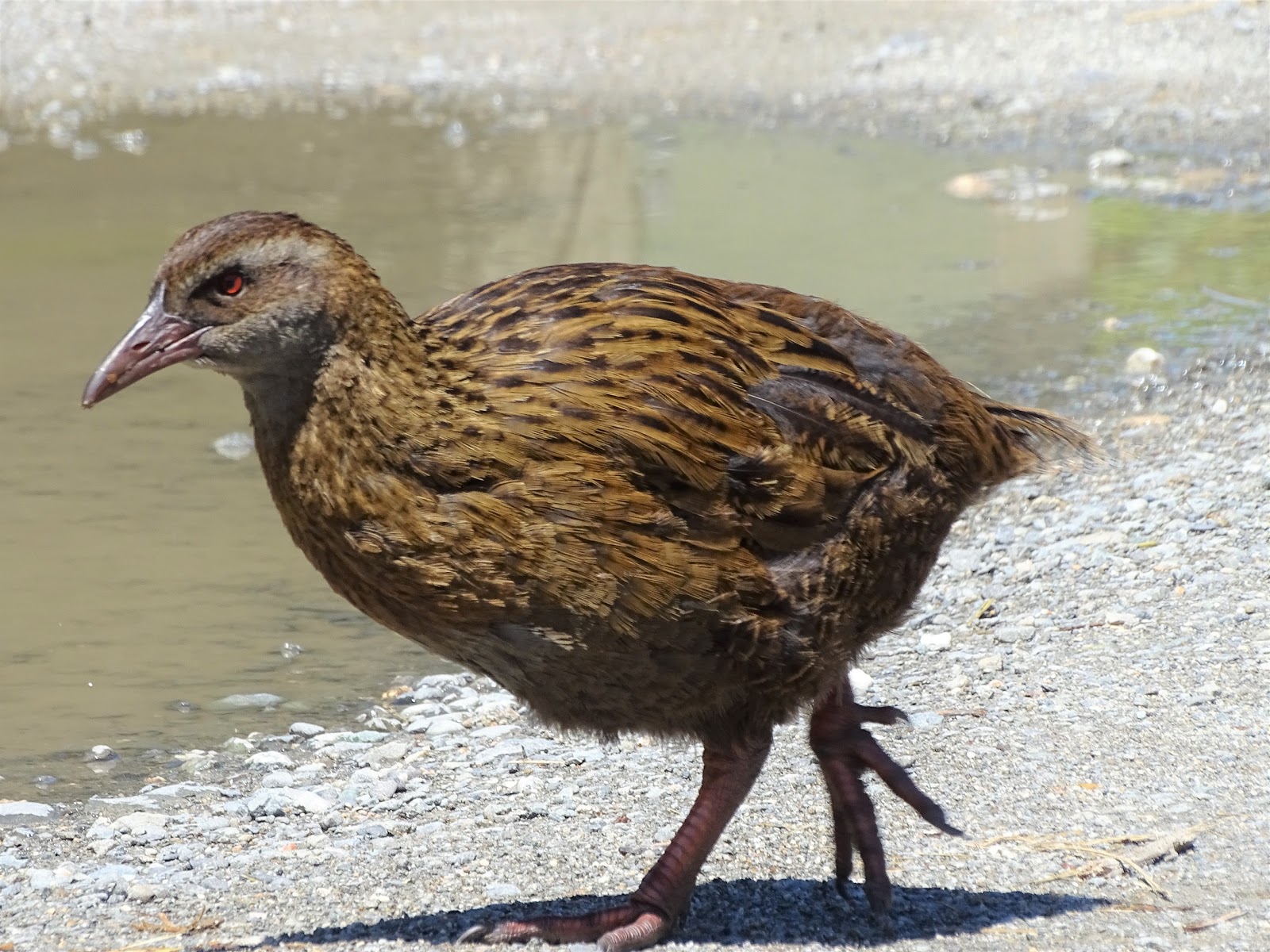
Weka are large rail like birds endemic to New Zealand which are not too dissimilar to corncrakes in size and look, although they occupy completely different habitats. During our journey from Nelson to Arthur's Pass we stopped off at several lookouts and view points and found relatively tame weka walking around the car parks, including this bird at Hope Saddle Lookout.
Monday, 13 January 2020
A few New Zealand endemics
 |
| Photo: Double-banded plover. |
My planned Albatross Encounter trip from Kaikoura was disappointingly cancelled today due to strong winds, but actually it turned out well in the end. Yesterday I had seen plenty of seabirds well on the Whale watching trip and even briefly contemplated cancelling todays trip but decided to go ahead with it on the off chance that I would get something different. However when it was cancelled not only did I get a full refund but I was then able to head off to Kaikoura headland for a sea watch from there.
It was very impressive, the wind had driven many seabirds close inshore, especially Hutton's shearwater which were going past in their thousands. Also from the headland, at least 3 Salvin's albatross, southern royal albatross and white-capped albatross, plus 3 northern giant petrels.
Plenty of other birds today as well, including a new species for me, Double-banded plover.
Sunday, 12 January 2020
Albatross's from Kaikoura
 |
| Photo: Salvin's albatross. |
Whale watching Kaikoura
 |
| Photo: male Sperm whale diving |
Saturday, 11 January 2020
Black-billed Gulls in quake city

New Zealand sits on the Pacific Ocean's Ring of Fire and as such is hit by frequent earthquakes, with several in the past decade including the devastating 2011 quake which killed 185 people in Christchurch and demolished many buildings and severely damaged the city's cathedral. Earthquakes are a way of life and a constant threat and to the visitor the the city appears to be in a permanent state of being rebuilt.
Also damaged in the 2011 quake was a 17-storey office building in Armagh Road owned by PwC. Following the quake the building was demolished and cleared so that all that remains now is a hole in the ground which was the buildings basement as well as concrete foundations and metal reinforcing.
It's a bit of an eyesore to be honest, but amazingly in amongst the rubble and twisted steel the worlds most endangered gull has made itself at home in the Central Business District of New Zealand's second most populous city.
Friday, 10 January 2020
A stop over in Singapore

On our way to New Zealand and Australia, we decided to stop off for three days in Singapore. It's absolutely not a birding stop but inevitably I was bound to pick up a few new species having never been to south-east Asia before. One of the commonest was this beautiful black-naped oriole and in total I managed 20 new species in Singapore. Most spectacularly I managed to find an unprecedented flock of 12 Himalayan Vultures themalling over the CPD, whilst most pleasing for me was getting a good look at blue-crowned hanging-parrots.
Thursday, 9 January 2020
Himalayan Vultures Singapore!

During a visit to Singapore CPD today I spotted 12 large birds thermaling overhead. Turns out they were Himalayan vultures which aren't even annual in Singapore, and although there have been 3 or 4 seen recently, 12 is unprecedented numbers. I reported the sighting on the Singapore birders Facebook group and since then there have been other sightings of the flock elsewhere in the country. Unfortunately I didn't have my camera with me and had to be content with these phone camera shots (not through the telescope!). Also today, blue-crowned hanging parrots, bright green, about the size of a sparrow, they habitually hang upside down and even sleep that way. My new favourite bird!

Singapore

Red junglefowl, one of several seen in Singapore Botanic Gardens. This is a species which occurs naturally in this part of south-east Asia but in Singapore some populations are under threat from hybridisation with domestic fowl. This bird looks pretty good to me but it's hard to know how pure it really is.
More to follow from Singapore soon...
Thursday, 19 December 2019
Masked and banded lapwings
 |
| Photo: Masked Lapwing ssp. novaehollandiae. |
They are of course the same species, but the Sydney bird is of the race novaehollandiae which is the race most likely to be encountered by overseas visitors to Australia, being found around Perth, Adelaide, Melbourne, Sydney and Brisbane, whilst the Exmouth bird is race miles which is found almost exclusively in the north from Cairns west to Darwin and Broome. Interestingly neither race should reach Exmouth according to my books.
 |
| Masked Lapwing ssp. miles. |
 |
| Photo: Banded Lapwing. |
Monday, 4 November 2019
Flowers of Western Australia

This was my fourth visit to Australia and on all of my previous visits I've bemoaned the lack of flowers and the lack of colour in the country. Sure the tropical rain forests of the north and the temperate rain forests of the south are wonderful places but they are predominantly green or grey.
The endemic Callistemon sp. or bottlebrushes do add some colour in places and they are beautiful and fascinating shrubs, but where were the more delicate flowering plants? In my first three visits I was unable to find them, ranging from Queensland, to Victoria, to Southern Australia, to Perth, I just didn't see any, or at least not significant amounts. Finally on this fourth trip to Western Australia I did find some colour! Most of the flowers were south of Perth which is not surprising since further north the land turns into virtually desert. I can't put names to most of these flowers, but here they are anyway.
Friday, 1 November 2019
My full Australian list to date
 |
| Photo: Blue-faced honeyeater. |
Species
|
Location
with number of birds seen in brackets
|
Arctic Skua
|
Port Fairy, Pelagic VIC (2)
|
Australasian Figbird
|
Atherton Tablelands QLD (30),
Brisbane, Banks Street Reserve QLD (1), Brisbane, City QLD (1), Cairns,
Esplanade QLD (10), Noosa QLD (1), Port Douglas QLD (30)
|
Australasian Gannet
|
Sydney, at sea NSW (2), Fraser
Island QLD (2), Noosa, Noosa Headland QLD (10), Coffin Bay, Coffin Bay
National Park SA (10), Fisherman's Bluff SA (3), Fishery Bay SA (2), Lincoln
National Park, Jussieu Peninsula SA (10), Port Lincoln SA (2), Port Lincoln,
Axel Stenross maritime museum SA (2), Port Lincoln, Billy Lights Point SA
(11), Port Lincoln, Parnkalla trail SA (15), Port Lincoln, Rock Beach SA (1),
Sleaford Bay SA (50), Whalers Way SA
(1), Melbourne, Port Melbourne VIC (15), Melbourne, St Kilda VIC (1), Phillip
Island VIC (2), Port Fairy, Pelagic VIC (400), Busselton WA (1), Cape Leeuwin
WA (5), Cape Naturaliste, Lighthouse WA (30), Cape Naturaliste, Sugarloaf
Rock WA (2), Dunsborough, Whale Watching WA (5), Fremantle to Rottnest ferry
WA (2)
|
Australasian Grebe
|
Sydney, Centennial Park NSW (2),
Bauple QLD (2), Brisbane, Biami Yumba Park and Fig Tree Pocket QLD (2),
Brisbane, Dowse Lagoon QLD (20), Hervey Bay QLD (10), Hervey Bay, Arkarra
Wetlands QLD (2), Hervey Bay, Booral Road QLD (1), Kin Kin QLD (1), Noosa,
Botanic Gardens QLD (1), Noosa, Jabiru Park QLD (25), Port Douglas QLD (1),
Port Lincoln, Billy Lights Point SA (1), Bellarine Peninsula, Jerringot
Wetlands VIC (5), Lara, Serendip Reserve VIC (3), Melbourne, Royal Botanical
Gardens VIC (1), Melbourne, Westgate Park VIC (2), Werribee, Western
Treatment Plant VIC (4), Perth, Herdsman Lake WA (50), Perth, Lake Monger
Reserve WA (50)
|
Australasian Shoveler
|
Brisbane, Dowse Lagoon QLD (4),
Noosa, Jabiru Park QLD (5), Big Swamp SA (20), Port Lincoln, Billy Lights
Point SA (10), Bellarine Peninsula, Jerringot Wetlands VIC (1), Werribee,
Western Treatment Plant VIC (50), Perth, Herdsman Lake WA (30), Perth, Lake
Monger Reserve WA (5)
|
Australasian Swamphen
|
Sydney, Centennial Park NSW (50),
Atherton Tablelands QLD (2), Bauple QLD (1), Brisbane, Biami Yumba Park and
Fig Tree Pocket QLD (30), Brisbane, City QLD (1), Brisbane, Dowse Lagoon QLD
(10), Gympie, Lake Alford QLD (10), Hervey Bay QLD (100), Hervey Bay, Arkarra
Wetlands QLD (10), Hervey Bay, Booral Road QLD (4), Hervey Bay, Burrum Heads
QLD (2), Noosa, Botanic Gardens QLD (2), Noosa, Jabiru Park QLD (20), Noosa,
Water treatment works QLD (20), Port Douglas QLD (30), Bellarine Peninsula,
Jerringot Wetlands VIC (30), Bellarine Peninsula, Lake Lorne VIC (40),
Melbourne, Royal Botanical Gardens VIC (10), Phillip Island VIC (10),
Werribee, Western Treatment Plant VIC (200), Wilson's Promontory VIC (2),
Perth, Herdsman Lake WA (200), Perth, Lake Monger Reserve WA (50)
|
Australian Brush-turkey
|
Atherton Tablelands QLD (3),
Brisbane, Banks Street Reserve QLD (10), Brisbane, Biami Yumba Park and Fig
Tree Pocket QLD (1), Brisbane, Lone Pine Koala Sanctury QLD (10), Brisbane,
Plantation Redhill QLD (2), Daintree, Mossman Gorge QLD (1), Hervey Bay,
Burrum Heads QLD (1), Kuranda QLD (2), Noosa, Noosa Headland QLD (2),
Seventeen Seventy QLD (4), Seventeen Seventy, Campsite QLD (5)
|
Australian Bustard
|
Minolta - Exmouth Road WA (4) |
Observations of Australian birds and mammals by state and location

Here's a full list of the 353 bird species and 36 mammal species I've seen so far in Australia, grouped by state and location. The numbers in brackets are the maximum number of individuals I have seen at each location.
State
|
Location
|
Species seen with maximum numbers in brackets
|
NSW
|
Blue Mountains
|
Australian Magpie (10), Australian
Raven (1), Australian Wood Duck (2), Bell Miner (20), Black-faced
Cuckoo-shrike (1), Brown Thornbill (2), Common Myna (30), Crescent Honeyeater
(1), Crimson Rosella (20), Eastern Spinebill (1), Fan-tailed Cuckoo (1),
Galah (10), Golden Whistler (5), Grey Fantail (1), Lewin's Honeyeater (1),
Magpie-lark (1), Masked Lapwing (1), Pacific Black Duck (2), Peregrine (1),
Pied Currawong (10), Red Wattlebird (10), Red-whiskered Bulbul (10), Satin
Bowerbird (2), Sulphur-crested Cockatoo (50), Welcome Swallow (20),
White-browed Scrubwren (10), White-throated Treecreeper (2)
|
NSW
|
Sydney
|
Australasian Gannet (2),
Australasian Grebe (2), Australian Darter (2), Australian Magpie (6),
Australian Pelican (8), Australian Raven (5), Australian White Ibis (300),
Australian Wood Duck (30), Black Swan (20), Black-browed Albatross (1),
Caspian Tern (1), Channel-billed Cuckoo (1), Chestnut Teal (10), Common Myna
(50), Coot (200), Cormorant (2), Crested Pigeon (10), Crested Tern (2), Dusky
Moorhen (30), Fairy Martin (15), Fluttering Shearwater (500), Grey
Butcherbird (2), Hardhead (100), House Sparrow (1), Intermediate Egret (3),
Kelp Gull (2), Laughing Kookaburra (2), Little Black Cormorant (15), Little
Pied Cormorant (20), Little Raven (1), Magpie-lark (10), Masked Lapwing (20),
Nankeen Kestrel (1), New Holland Honeyeater (10), Noisy Miner (50), Pacific
Black Duck (4), Peregrine (1), Pied Cormorant (4), Pied Currawong (5), Purple
Gallinule (50), Rainbow Lorikeet (30), Red Wattlebird (3), Short-tailed Shearwater
(200), Silver Gull (1000), Spotted Dove (5), Starling (50), Sulphur-crested
Cockatoo (20), Superb Fairy-wren (10), Wedge-tailed Shearwater (500), Welcome
Swallow (50), White-browed Scrubwren (3), White-faced Heron (1), Willie
Wagtail (2), Yellow-tailed Black-Cockatoo (5)
Mammals: Humpback
whale, Indo-Pacific Bottlenose dolphin, New Zealand fur seal, grey-headed flying-fox
Key locations: Sydney botanic gardens, Centennial Park, Watson Bay, whale watching trip. |
QLD
|
Atherton Tablelands
|
Australasian Figbird (30),
Australian Brush-turkey (3), Australian Pelican (5), Black Kite (50),
Black-faced Monarch (2), Brown Treecreeper (1), Coot (20), Dusky Honeyeater
(2), Eastern Cattle Egret (50), Golden Whistler (5), Great Crested Grebe
(50), Large-billed Gerygone (10), Laughing Kookaburra (3), Little Eagle (1),
Magpie-lark (5), Mistletoebird (1), Olive-backed Sunbird (2), Pacific Black
Duck (6), Pied Currawong (2), Purple Gallinule (2), Rainbow Lorikeet (50),
Silvereye (1), Spangled Drongo (3), Spotted Harrier (1), Sulphur-crested
Cockatoo (10), Varied Triller (1), Whistling Kite (1)
Mammals: Duck-billed
platypus, Eastern grey kangaroo
Key locations: Yungaburra |
QLD
|
Avondale
|
Black Kite (20), Brown Honeyeater
(2), Double-barred Finch (3), Eastern Great Egret (1), Hardhead (1), Laughing
Kookaburra (15), Little Black Cormorant (30), Scarlet Honeyeater (2) |
Subscribe to:
Posts (Atom)
-
 Photo: Snowy albatross. "Wanderer at 6 o'clock!", the cry went up and sent shivers down my spine. This was the moment I ha...
 -
 Photo: New Holland Honeyeater. There are 76 species of honeyeater in Australia forming the largest family of Australian passerines. They...
 -
 I spent the low tide this afternoon on the southern end of Four Mile Beach, just at the point where the mangroves begin. It's a great sp...